Research · AI project2022 – 2024.02
Seismic interpretation of large overseas CO2 storage sites considering plate-tectonic history (first-author paper)
Reconstructed how large overseas CO2 storage sites formed and interpreted their seismic images from a structural-geology perspective
Problem
Korea needs ~30 Mt/yr of domestic CO2 storage by 2050, but there was little systematic analysis of how large storage sites form geologically
My role
As first author, compare large CO2 storage sites in four regions from a plate-tectonic viewpoint (submitted 2023.07, accepted 2023.12)
What I did
- Reconstructed the plate-tectonic history of four regions with GPlates (PALEOMAP PaleoAtlas)
- Interpreted seismic images of two representative CCS projects per region — Quest & Weyburn-Midale, Northern Lights & PORTHOS, Gorgon & Moomba, Uthmaniyah & Qatar LNG — focusing on reservoir and cap rock
- Short stay at Univ. of Calgary (2023.12–2024.02): processed gravity data from the Utah FORGE geothermal site
Results
- First-author paper: Analysis on Seismic Interpretation for Overseas Large-scale CO2 Storage Considering Geological History Related to Plate Tectonics, Geophysics and Geophysical Exploration 27(1), 1–22 (2024)
- Showed that stratigraphy in each seismic image reflects the region's tectonic history → a basis for rejecting geologically unrealistic velocity models when processing domestic data
- 1 second-author paper (CarbonNet CCS, Gippsland Basin, 2023) · 3 conference talks (2022–2023)
Decisions & trade-offs
What I chose, and what I gave up for it
Instead of going deep on one site, I compared eight projects in four regions with the same frame (plate-tectonic history → reservoir and caprock structure), prioritizing common patterns over per-site quantitative analysis.
Looking back · open questions
What I would change, and what is still open
Looking back: even when results look good numerically, 'it makes sense once you know how it formed' is the stronger evidence — the role domain constraints play in ML. It became the habit of comparing with independent models in my M.S. work.
Applying the proposed criterion (ruling out geologically unrealistic velocity models) to real domestic survey data remains open.
 2022 — conference badges (KSEG · K-CCUS)
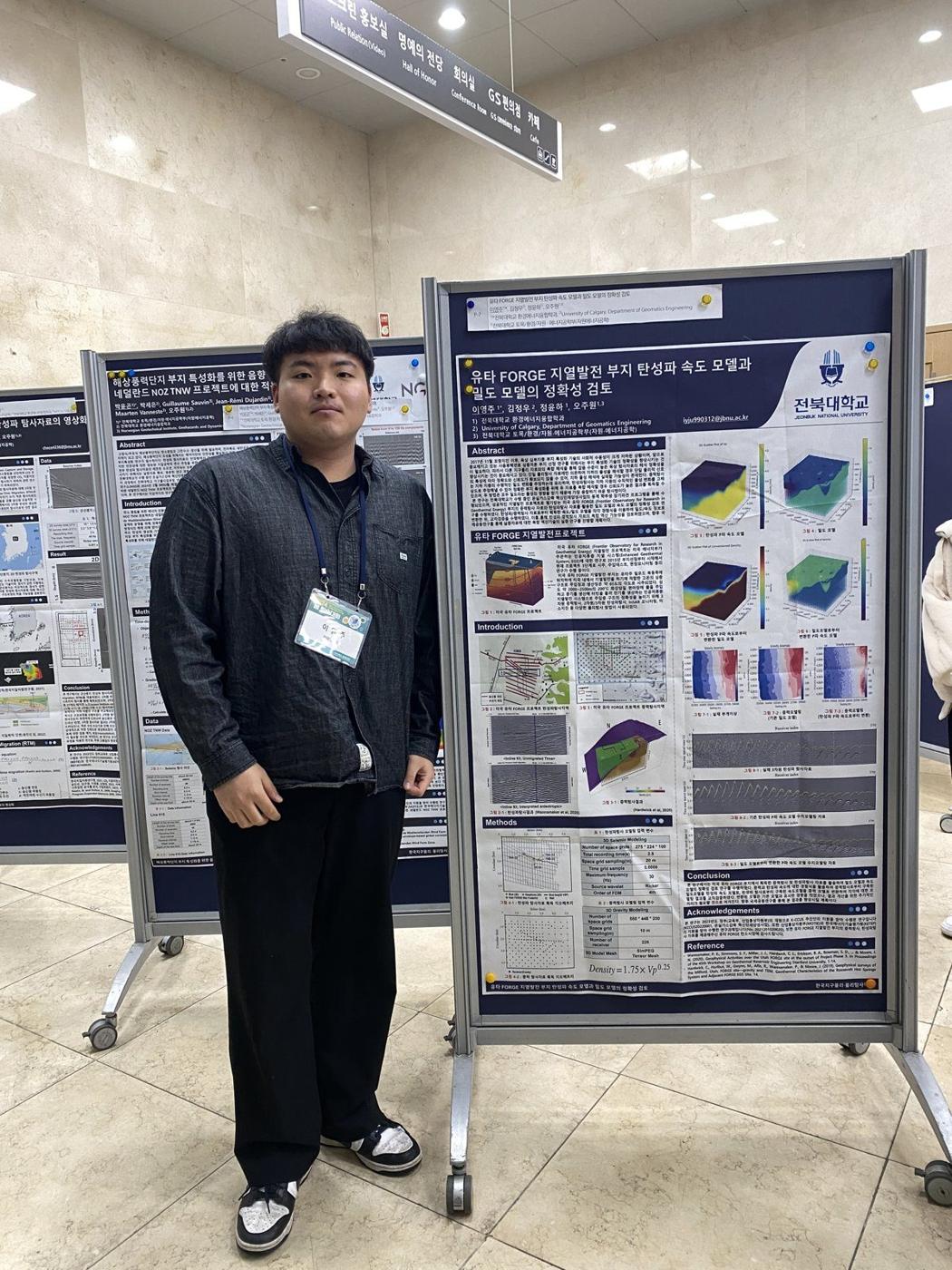 2024.04 — Utah FORGE poster presentation